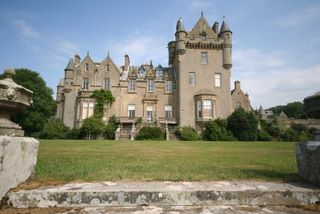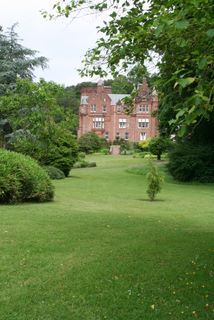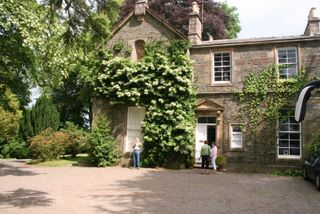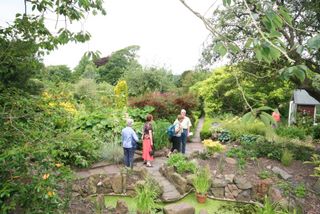
|
Dumfries and Galloway, in the
south-western corner of Scotland, is home
to some of the country's most attractive gardens. Under the
influence
of the mild, damp climate a spectacular range of plants can be grown
here, including exotic sub-tropical species. The jewel in the
crown is
perhaps Logan
Botanic Garden, Scotland's most exotic garden, with its
spectacular display of bizarre and unusual non-native species. We
visited some other gems as well, such as Glenwhan, lavishly
planted
with trees and shrubs, and Broughton
Garden, where E. A. Hornel lived
and which shows the influence of his time in Japan. We also
visited Threave Gardens,
where the National Trust for Scotland has its
own school of horticulture, and the internationally famous Castle
Kennedy, which boasts species rhododendrons and a vast collection
of
azalea, magnolia and embrothriums. Cally
Gardens and Nursery at
/gatehouse of Fleet and Elizabeth MacGregor
Nursery and Garden are two
of the country's finest plant centres and offer an excellent
opportunity to purchase something a little unusual for your own garden.
Friday 26th June 2009
We departed from the Barlow
Institute and Bromley Cross Railway Station and headed for Threave
Gardens. The gardens are owned by the National Trust of
Scotland
and have their own school of horticulture, having been largely created
by the students since the school started in 1960. Mature woodland
of beech, conifers and oaks form the background to a large collection
of shrub roses, sweeping mixed borders, dwarf heathers, peat and rock
gardens, a walled kitchen garden and superbly maintained glasshouses.
After our visit we
travelled to our comfortable accommodation at the 4-star North West
Castle Hotel in Stranraer. the hotel dates from 1820 when it
was
built for Sir John Ross, the arctic explorer, and enjoys superb views
over Loch Ryan. The food every night was suberb.
Saturday 27th June 2009
Following a good breakfast, we
headed for the fabulous Elizabeth MacGregor
Nursery and Garden and an
opportunity perhaps to take home some plants as a souvenir of our trip.
Hereafter we visited Broughton
Gardens, a fascinating 18th Century house and garden which
was
home to E. A. Hornel from 1901 until his death in 1933. During
his time he had twice lived in Japan and his experience there
influenced many of his paintings. The garden which runs down to
the estuary of the Dee also shows the influence of his time in Japan
and is always full of colour.
Our last visit of the day was to Cally
Gardens and Nursery at Gatehouse of Fleet. Set in a 3 acre
walled garden, Michael Wickenden has a treasure trove of plants and
runs a truly marvellous nursery with an emphasis on unusual herbaceous
perennials - most of which are on display. This is truly one of
the country's finest plant centres and offered an excellent opportunity
to purchase something a little unusual for your own garden.
Dinner was served at the hotel in
the evening.
Sunday 28th June 2009
Following breakfast we visited
the world famous Logan
Botanic Garden at Port Logan. Port Logan
lies in the Mull of Galloway, which juts out into the sea in the
extreme south-west of Scotland. The garden was started by the
McDougall family who lived here for 800 years and since 1969 it has
been in the care of the Royal Botanic Garden at Edinburgh. Logan
Botanic Garden is beautifully laid out, particularly in the walled
garden with its fine terraces and well planned borders under an avenue
of cabbage palms.. The climate here is exceptionally mild and
several different habitats provide conditions for a huge range of
plants.
Our next visit was to Glenwhan
Gardens, spread out over a windy hilltop with marvellous views of
Luce
Bay and the Mull of Galloway. Since 1979 the Knotts have made a
very large, interesting an individual garden that is filled with good
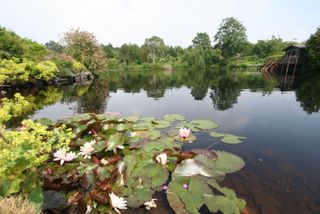
plants. At its heart is an extensive pool, divided by a grassy
causeway and fed by a tumbling stream. The slopes above are
lavishly planted with trees and shrubs - almost any gardener will find
something unfamiliar here.
After breakfast we checked out of
the hotel for our return journey whilst the coach driver struggled to
load all our plants.
We
stopped
en route at the Castle
Kennedy Gardens, one of Scotland's most
famous gardens, which is both important and impressive - 75 magnificent
acres set in an area of outstanding beauty. The gardens were
originally laid out in 1730 around the ruins of Castle Kennedy by the
2nd Earl of Stair, who reshaped the landscape on a grand scale.
The gardens are internationally famous for their species rhododendrons,
including many of Sir Joseph Hooker's original introductions from his
Himalayan expedition. These, along with a vast collection of
azaleas, magnolias, and embrothriums give spectacular colour in
late May/June. Other features of interest included an
internationally famous 19th Century pinetum, with a wide variety of
tender trees, a monkey puzzle avenue, the walled garden and an
impressive two acre circular lily pond. Situated between two
beautiful natural lochs, the gardens offer visitors a choice of walks
through the avenues and along the terraces. After rushing down a
light lunch of sandwiches we left to visit the relatively small,
private garden of James and Carol Coutts near Dumfires.
This garden of 1.2 acres was new
to visitors and is at Newtonairds Lodge, a Scottish sandstone Baronnial
Lodge House to the former Newtonairds estate. the main attraction
is a National Collection of Hosta Plantaginea cvs. & hybrids of
which most have fragrant flowers. It is the only collection of
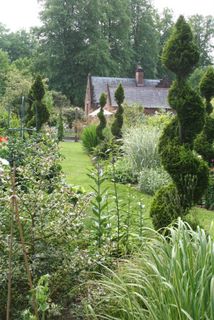
fragrant flowered hostas in the UK. It is a plantsmans garden
with many topiaries and shrubs, also hundreds of different perennials
and large plantings of fragrant oriental lilies. There is also a
rose circle containing vegetables from Heritage seed. James and
Carol have developed the garden from a largely blank canvas 5 years ago
and it is pesticide free and patrolled by free range Indian Runner
Ducks.
|